
 English
  Français
  Español
  Deutsch
  عربى
عربى 

How Does an Outdoor Glider Sofa Work?
An outdoor glider sofa moves on a forward-and-back linear gliding mechanism rather than the arc-shaped pendulum movement of a porch swing. The seat and backrest assembly rests on a base frame connected by two parallel sets of linkage arms. When a seated occupant shifts weight, the linkage arms allow the seat to travel smoothly in a horizontal plane — forward approximately 4–6 inches, then back — without the frame itself moving.
This mechanism distinguishes a glider from both a rocking chair (which tips on curved runners, changing the seat's angle relative to the ground) and a porch swing (which suspends from above and arcs through a wider vertical path). The glider's horizontal travel keeps the occupant's body angle constant throughout the motion, which is why it is considered more ergonomically stable for extended sitting — particularly for adults with lower back sensitivity or for use while holding a drink or a child.
How Does an Outdoor Glider Sofa Compare to a Standard Patio Sofa?
| Feature | Outdoor Glider Sofa | Standard Patio Sofa |
|---|---|---|
| Motion | Smooth forward-and-back glide, ~4–6 in. travel | None — fully stationary |
| Comfort for extended sitting | Higher — gentle motion reduces fatigue, aids circulation | Dependent entirely on cushion quality |
| Ergonomic stability | Seat angle remains constant throughout motion | Static, consistent angle |
| Mechanism maintenance | Pivot points require occasional inspection | No moving parts |
| Weight | Heavier — base frame + linkage assembly | Lighter |
| Space requirement | Needs ~12 in. clearance behind for travel | Can be placed against wall |
| Visual impact | Distinctive presence — conversation piece | Conventional silhouette |
| Price point | Premium — 30–50% above comparable static sofa | Standard market rate |
| Best setting | Covered porch, screened lanai, resort lounge | Open patio, poolside, dining terrace |
| Retail differentiation | High — limited competition in the category | Highly competitive category |
What Materials Are Used in Outdoor Glider Sofas?
Aluminum Frame with Powder Coating
Cast and extruded aluminum dominates the premium outdoor glider sofa market because of its combination of low mass, structural rigidity, and complete rust immunity. The linkage mechanism — the component most vulnerable to corrosion in a moving outdoor product — must use either aluminum or 304 stainless steel hardware. A glider sofa with steel mechanism bolts in a coastal environment will begin to seize within 2–3 seasons, while aluminum throughout extends service life to 10–15 years.
Powder coat thickness on aluminum glider frames should be specified at minimum 80 microns for outdoor use, with thicker deposits (100+ microns) recommended for coastal or high-UV environments. Quality manufacturers apply an electrostatic powder coat to the fully assembled frame rather than individual components, ensuring consistent coverage at weld points and corners — the locations most prone to early finish failure.
Cushion Fabric and Fill
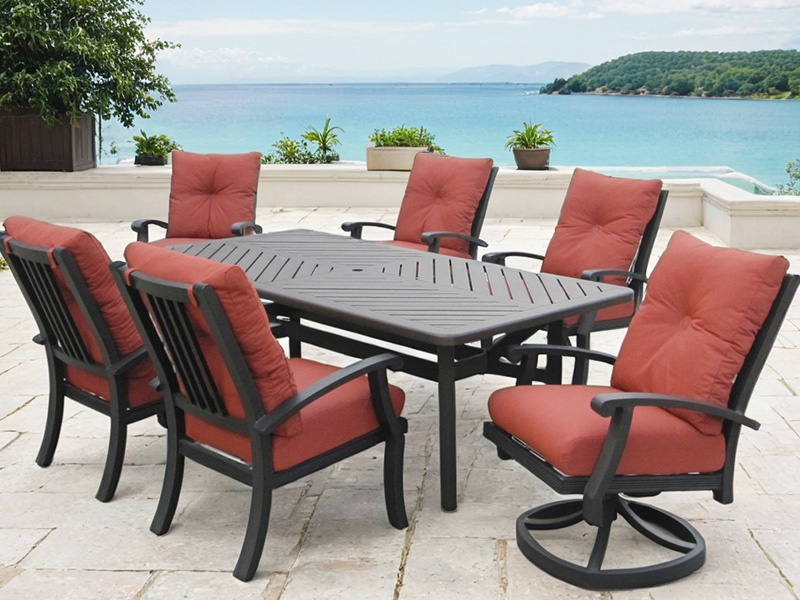
Outdoor glider sofas are used most intensively in covered or semi-covered settings — porches, pavilions, and resort lounge areas — where cushions are semi-permanently placed rather than stored daily. This demands solution-dyed acrylic fabric (Sunbrella-grade or equivalent) that resists UV fade, mildew, and moisture absorption. Quick-dry foam or hollow-fiber fill that allows water to drain and evaporate rather than retain moisture is essential for cushions that remain outdoors across an entire season.
Sling vs. Cushion Configuration
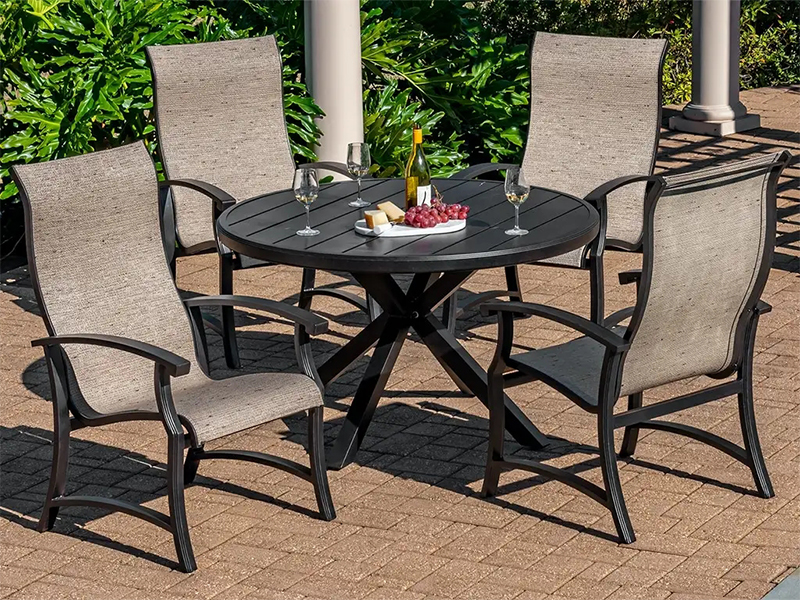
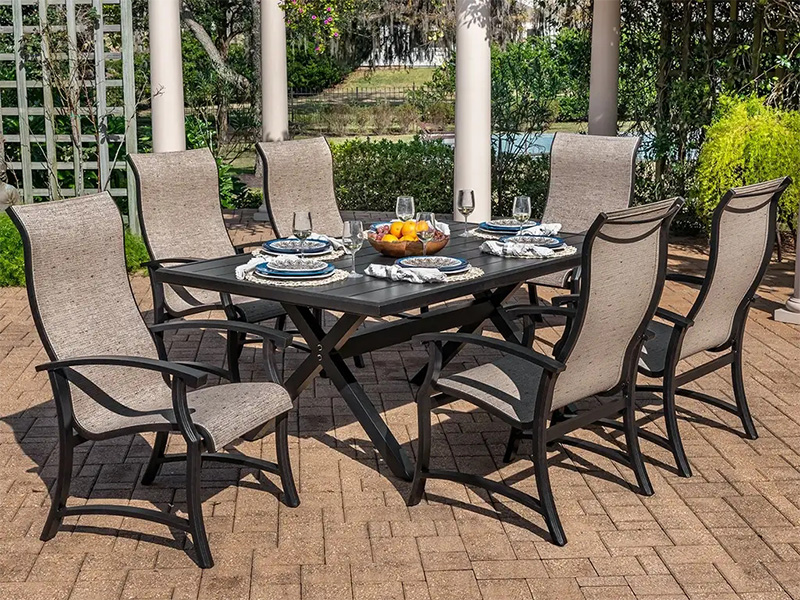
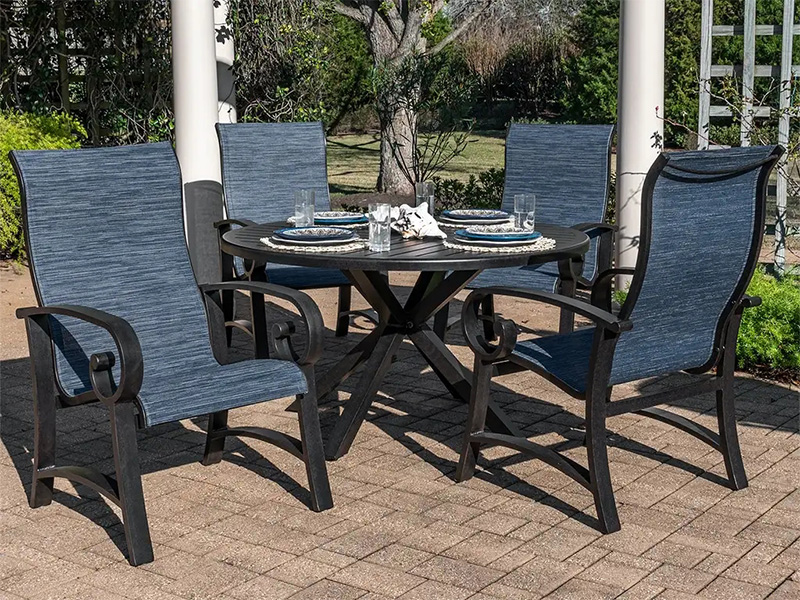
Some outdoor glider sofas use a continuous sling fabric stretched across the seat and backrest frame rather than loose cushions. Sling configuration eliminates the cushion storage and cleaning concern entirely — sling fabric dries within minutes of rain and requires only a wipe-down for maintenance. For hospitality settings managing multiple seating areas with limited housekeeping staff, sling-configuration glider sofas significantly reduce operational overhead versus cushion models.
Which Environments Are Best Suited to an Outdoor Glider Sofa?
Covered Front Porch and Screened Lanai
The traditional and most natural setting for an outdoor glider sofa is the covered front porch — a partially protected space where the furniture is present year-round but shielded from direct precipitation. The gentle motion of the glider is well-suited to the contemplative character of porch sitting: watching the neighborhood, reading, or conversation. In warmer climates, the screened lanai serves the same function and benefits equally from the air-movement effect of the gliding motion, which provides a subjective cooling sensation on warm evenings without a breeze.
Resort and Hotel Veranda
High-end resort properties — particularly in tropical, island, and mountain settings — use outdoor glider sofas to create distinctive seating vignettes on verandas, around fire features, and at spa terraces. The motion element gives guests an experiential quality beyond standard lounge seating, and in a hospitality photography context, a glider sofa in motion creates visual dynamism that static furniture cannot replicate. For resort buyers sourcing contract furniture, cast aluminum glider sofas with custom powder-coat colors and brand-matched fabric represent a meaningful opportunity to reinforce property identity through furniture specification.
Senior Living Community Outdoor Areas
Outdoor glider sofas are a preferred specification for senior living community patios, courtyards, and garden terraces. The smooth, low-effort gliding motion provides a self-directed activity — gentle movement that is physically beneficial for circulation without the physical demand or risk of rocking chairs. The stationary base frame means the unit will not slide on smooth outdoor surfaces, an important safety consideration in assisted living settings. Specifiers for these projects should confirm that the glider mechanism operates with minimal effort — ideally less than 5 lbs of force — so that it remains accessible to residents with limited mobility.
Frequently Asked Questions
Does an outdoor glider sofa need to be anchored to the floor?
No — a correctly designed outdoor glider sofa's base frame remains stationary during use due to its footprint and weight distribution. The gliding action is entirely self-contained within the mechanism. However, for rooftop installations or high-wind environments, some buyers choose to add rubber non-slip pads under the base legs to prevent any shifting on smooth decking surfaces. Permanent anchoring is not typically necessary or recommended, as it limits the flexibility to reposition the furniture seasonally.
How does an outdoor glider sofa differ from a porch swing?
A porch swing suspends from an overhead beam or ceiling hook and moves in a pendulum arc — higher at each end of the swing arc than at the resting point. This requires overhead mounting infrastructure and produces a wider, more dramatic movement. An outdoor glider sofa sits on its own self-contained base frame, requires no overhead mounting, and moves in a controlled horizontal plane. The glider is the practical choice for patios and terraces without overhead suspension points; the swing is the more dramatic choice where mounting infrastructure exists and space allows the arc clearance on both sides.
Can outdoor glider sofas be used with a matching loveseat or chair set?
Yes — premium outdoor furniture manufacturers produce glider sofas designed to match their standard seating collections in frame finish, fabric options, and aesthetic style. A coordinated outdoor seating group might include one glider sofa as the anchor piece, flanked by two stationary club chairs or a matching glider loveseat, all in the same cast aluminum frame and powder-coat finish. This approach allows buyers to mix motion and static seating within a single cohesive collection rather than committing an entire seating area to the higher-cost glider product.
How do you maintain an aluminum outdoor glider sofa?
Aluminum frame maintenance is minimal — wash with mild soap and water once per season and rinse thoroughly. The glider mechanism pivot points should be inspected annually; if stainless steel hardware is used, no lubrication is necessary in most climates. For environments with heavy salt-air exposure (within 1 km of open ocean), a light application of silicone-based lubricant on pivot bolts each season extends mechanism smoothness. Cushions in solution-dyed acrylic fabric can be cleaned with diluted bleach solution (max 1:4 bleach: water) without color damage — a significant maintenance advantage over standard polyester outdoor fabrics.