
 English
  Français
  Español
  Deutsch
  عربى
عربى 

A fire pit table does what no other single piece of outdoor furniture can: it creates a focal point, extends the usable season, and transforms a patio from a daytime space into an evening destination. For hospitality buyers and outdoor furniture retailers, it is consistently one of the highest-value SKUs per square foot of floor space.
What Is a Fire Pit Table and How Does It Work?
A fire pit table combines the function of a low coffee or center table with an integrated gas burner recessed into the tabletop. The burner sits inside a fire bowl surrounded by decorative media — typically lava rock, fire glass beads, or ceramic logs — and connects to a propane tank stored inside the cabinet base or to a natural gas line via a quick-connect fitting.
Most modern models use an electronic ignition system activated by a push-button or turn-knob, eliminating the need for matches or lighters. BTU output typically ranges from 40,000 to 65,000 BTU/hr for residential-grade units, while commercial hospitality-grade tables may reach 80,000 BTU/hr to heat larger seating areas efficiently.
The surrounding tabletop surface — made of aluminum, cast aluminum, or powder-coated steel — functions as a normal table when the burner is covered with the included lid, adding year-round utility beyond the heating season.
How Does a Fire Pit Table Differ from a Standalone Fire Pit?
| Feature | Fire Pit Table | Standalone Fire Pit |
|---|---|---|
| Furniture function | Full tabletop surface when lid closed | None — decorative/heating only |
| Placement | Center of seating group, replaces coffee table | Standalone, requires clearance all around |
| Fuel type | Propane or natural gas (clean, controllable) | Wood, propane, or natural gas |
| Safety | No sparks, no ash, automatic shutoff | Wood models produce sparks and ash |
| Heat output control | Adjustable flame height via valve | Variable (wood) or adjustable (gas) |
| Space efficiency | Replaces a table — no extra footprint | Requires a dedicated space outside seating |
| Aesthetic | Integrated, furniture-grade finish | Industrial/rustic, not part of the furniture set |
| HOA / rental compliance | Gas models are widely permitted indoors/covered | Wood models are often restricted |
| Retail price positioning | Premium — justifies higher ASP for retailers | Budget to mid-range |
What Materials Are Used in Outdoor Fire Pit Tables?
Cast Aluminum Frame and Tabletop
Cast aluminum is the dominant material in premium fire pit tables for good reason. It is inherently rust-proof (no iron content), lightweight enough for two people to reposition, and accepts intricate casting detail — woven textures, lattice panels, and decorative aprons — that match the aesthetic of a full dining or seating set. Powder-coated finishes in bronze, slate grey, antique black, and champagne offer long-term UV and weather resistance without the maintenance burden of wrought iron.
Extruded Aluminum Base with Concrete or Stone Tabletop
A growing trend in contemporary hospitality design pairs an extruded aluminum frame with a concrete-look fiber-reinforced concrete (FRC) or porcelain-on-steel tabletop. These materials tolerate the thermal cycling from burner heat better than natural stone, which can crack under repeated heating and cooling. For rooftop bars and boutique hotel terraces targeting an architectural aesthetic, this combination photographs exceptionally well and commands a higher retail price point.
Steel with Powder Coating
Heavy-gauge steel fire pit tables carry more visual mass and lower material cost, but require a robust powder coat — minimum 80 microns — plus a rust-inhibiting primer to perform adequately in coastal or high-humidity environments. For inland residential retail, steel is a viable mid-market option; for contract hospitality sourcing, cast aluminum is the professional standard.
Key Specifications to Review When Sourcing Fire Pit Tables
Which Outdoor Settings Benefit Most from a Fire Pit Table?
Residential Patio and Backyard
For homeowners assembling a complete outdoor seating group, a fire pit table replaces the center coffee table while adding evening entertainment value. Matching the fire pit table to the existing dining set frame finish — cast aluminum in antique bronze, for instance — gives the patio a unified, furniture-collection look. Retailers sourcing coordinated sets sell larger average basket sizes as customers purchase fire pit tables alongside sectionals, club chairs, and dining sets from the same manufacturer.
Hotel Pool Deck and Lounge Terrace
Hospitality buyers sourcing pool decks and rooftop terraces prioritize natural gas conversion capability and high BTU output for large seating groups. Contract quantities require consistent powder-coat color matching across multiple units and minimum lead times of 60–90 days for custom colorways. Fire pit tables positioned at seating vignettes on a hotel terrace drive incremental food and beverage revenue — guests linger longer around a fire, increasing per-cover spend.
Restaurant and Bar Outdoor Section
Commercial outdoor dining spaces in markets with cooler shoulder seasons — the US Pacific Northwest, Northern Europe, and elevated resort areas — use fire pit tables to extend the viability of outdoor seating into October and March. A 40,000-BTU table warming a 6-seat conversation cluster can directly increase covers without expanding the physical footprint.
Vacation Rental and Short-Term Rental Properties
A fire pit table has become a near-standard amenity expectation on Airbnb and VRBO listings for properties with outdoor spaces. Property managers sourcing multiple units require consistent quality, straightforward assembly, and durable finishes that survive multiple guest seasons without refinishing. Cast aluminum frames with electrostatically applied powder coating meet this durability requirement while keeping maintenance labor minimal.
How to Match a Fire Pit Table to an Existing Seating Set
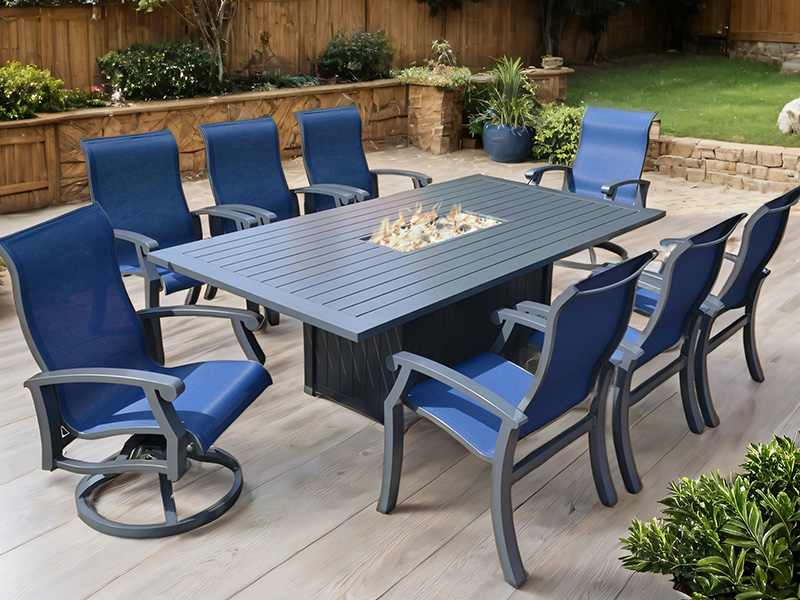
Frame finish coordination matters as much as size. If the seating set uses a deep charcoal powder coat with sling fabric in graphite and cream, a matching charcoal fire pit table with dark lava rock creates a cohesive collection; switching to bright fire glass in amber or cobalt introduces a deliberate accent. When sourcing OEM furniture as a coordinated collection, specifying the fire pit table frame in the same powder-coat batch as the seating ensures color consistency across units — something only achievable when working directly with the manufacturer.
Frequently Asked Questions
Can a fire pit table be used on a covered patio or pergola?
Gas fire pit tables — propane and natural gas — are generally acceptable under covered structures when adequate clearance exists between the flame and the overhead structure (typically a minimum of 80 inches). Always verify with local building codes and the specific product's installation instructions. Wood-burning fire pits are not suitable for covered installations. For commercial hospitality applications, the venue's fire safety officer should approve placement before installation.
What is the difference between propane and natural gas fire pit tables?
Propane fire pit tables connect to a portable 20-pound tank stored inside the cabinet — the most flexible option for residential use since no plumbing is required. Natural gas models connect permanently to a home or venue gas line via a quick-connect fitting, eliminating the need to monitor or replace tanks. Most quality fire pit tables are supplied propane-ready with a natural gas conversion kit included or available as an accessory. For hotel terraces and restaurant outdoor sections with permanent infrastructure, natural gas is the operational preference.
How long does a 20 lb propane tank last with a fire pit table?
At a mid-range flame setting (approximately 40,000 BTU/hr), a standard 20-pound propane tank provides roughly 4–5 hours of burn time. At lower flame settings — adequate for ambiance rather than heating — run time extends to 8–10 hours. For commercial applications requiring all-evening operation, a natural gas connection is strongly recommended to avoid operational interruptions.
What BTU output is right for a residential fire pit table?
For a typical residential patio seating group of 4–6 people, a 40,000–50,000 BTU output provides meaningful warmth within the immediate seating area. Higher BTU output (60,000+) is better suited to large open terraces or commercial settings where the seating group is more spread out. Buyers should note that flame height — not just BTU rating — affects the visual drama of the fire; some mid-BTU burners with quality stainless steel ring burners produce a more impressive flame than higher-rated competitors with cheaper burner designs.